

Rubidium Market to Near 11.96 Tons by 2035 as Quantum Computing and 5G Timing Reshape a Niche Metal
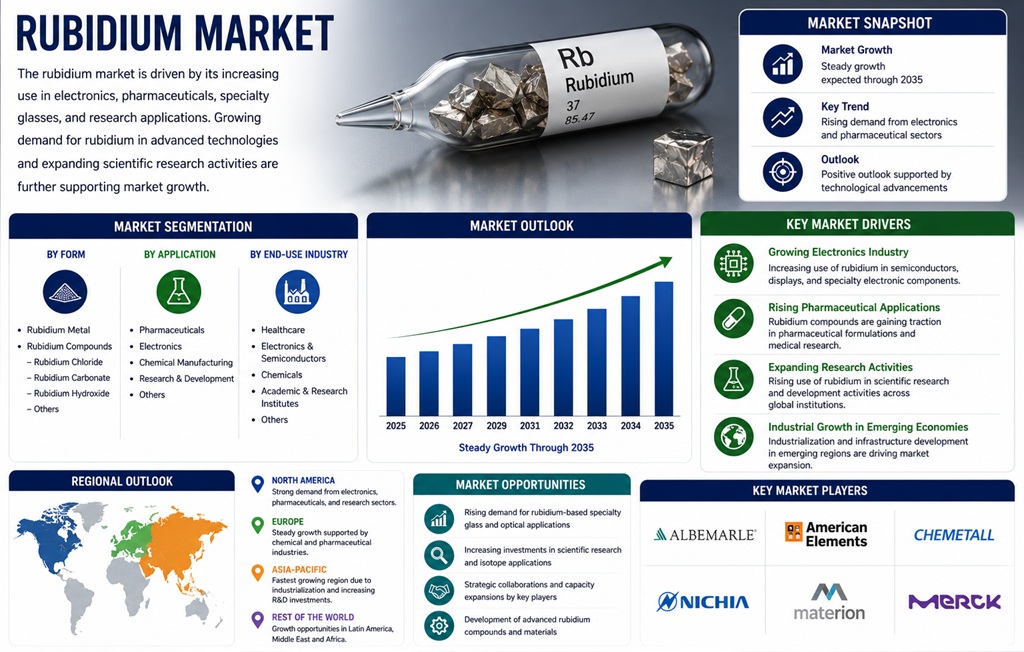
Rubidium Market (2026 - 2035)
North America recorded the second-largest share, with quantum-computing procurement programs accelerating demand.
GA, UNITED STATES, July 16, 2026 /EINPresswire.com/ -- According to a comprehensive report by Market Research Future (MRFR), the global rubidium market reached an estimated 7.44 tons in 2025 and is projected to grow from 7.79 tons in 2026 to 11.96 tons by 2035, registering a compound annual growth rate of 4.87%. This modest volume masks a profound strategic importance: rubidium is becoming a critical enabler of the digital infrastructure, defense systems, and medical diagnostics that define modern civilization.The 5G/6G Timing Imperative: Atomic Clocks as Network Backbone
The single largest demand driver for the rubidium market is the global deployment of 5G telecommunications infrastructure—and the emerging planning for 6G. Every 5G macro base station needs a precision timing source, and rubidium oscillators have become the go-to mid-tier option between more expensive cesium or GPS-disciplined clocks and less accurate crystal oscillators. By 2028, the GSMA projects that more than 15 million 5G base stations will be deployed worldwide, with rubidium clock attach rates rising with each small-cell densification cycle. Even a 12–15% rubidium penetration rate translates into significant volume demand during the projection period.
The ITU's IMT-2030 framework envisions sub-microsecond synchronization for 6G networks, a requirement that strongly favors atomic-clock timing over GPS-disciplined alternatives vulnerable to spoofing and jamming. Rubidium oscillators sit at the performance-cost sweet spot for densified base-station architectures, positioning the rubidium market to benefit from each successive mobile-network generation through 2035 and beyond. Ericsson's 2024 Mobility Report estimated yearly base-station shipments at 3.2 million units, creating a steady demand pipeline that is largely insensitive to economic cycles.
Legacy cesium-based frequency standards are steadily yielding ground to chip-scale rubidium atomic clocks that offer comparable precision at a fraction of the size, weight, and power draw. Microsemi (now part of Microchip Technology) and other chip-scale atomic clock (CSAC) manufacturers are driving rubidium oscillator modules below 35 cm³ volume envelopes. This miniaturization opens applications in autonomous vehicles, handheld military GPS receivers, and underwater navigation—sectors currently served by lower-accuracy crystal oscillators. Each CSAC unit consumed represents new incremental demand for the rubidium market, expanding the addressable base beyond traditional telecom infrastructure.
Download Report Sample Copy with TOC: https://www.marketresearchfuture.com/sample_request/27298
Quantum Computing: From Laboratory to Commercial Pilot
The second transformative demand driver is the commercialization of neutral-atom quantum computing. Neutral-atom quantum processors—developed by firms such as QuEra Computing, Pasqal, and Atom Computing—rely on arrays of laser-cooled rubidium-87 atoms as qubits. The U.S. National Quantum Initiative Act allocated USD 1.2 billion through 2028 for quantum research, while the EU Quantum Flagship has committed EUR 1 billion over ten years. As these platforms transition from sub-100-qubit prototypes to 1,000+ qubit pilot systems, per-unit rubidium consumption rises substantially, creating a durable demand floor through 2035.
Neutral-atom quantum processors are projected to cross the 10,000-qubit threshold before 2032, according to roadmaps published by QuEra and Pasqal. Each scaling step increases per-system rubidium loading, and a fleet of 50–100 commercial quantum machines globally could consume 0.5–0.8 tons annually—a non-trivial fraction of today's total rubidium market. Securing long-term rubidium supply contracts will become a strategic priority for quantum hardware OEMs as they move from research grants to commercial revenue.
The quantum opportunity extends beyond computing. Rubidium vapor cells are integral to quantum magnetometers, gravimeters, and emerging quantum key distribution (QKD) networks. The UK National Quantum Technologies Programme allocated GBP 106 million to quantum sensing applications in 2024. Commercialization of these devices—from geological surveying to submarine detection—could add an entirely new demand vertical that barely exists today.
Biomedical Research: Rb-82 Cardiac PET Imaging
The third major demand pillar is medical imaging. Rubidium-82 chloride generators enable rapid myocardial perfusion PET scans with superior sensitivity compared to SPECT alternatives. The American Society of Nuclear Cardiology reported a 14% annual increase in Rb-82 scan volumes since 2023, and CMS reimbursement rates for cardiac PET remain favorable at approximately USD 1,800 per procedure. Hospital systems across the U.S. and Western Europe are installing dedicated Rb-82 generators, locking in recurring rubidium demand that bolsters the market independent of industrial cycles.
The WHO projects cardiovascular disease burden to rise 22% globally by 2035, directly expanding the addressable rubidium market in medical channels. AI-assisted cardiac image interpretation is reducing scan-to-diagnosis turnaround times, making the modality attractive to high-throughput hospital systems. Automated stressor-perfusion protocols could further lower per-scan costs, accelerating adoption in middle-income countries.
Cardiac PET imaging remains heavily concentrated in North America and Western Europe, but hospital systems across India, Brazil, and the Gulf states are investing in nuclear-medicine infrastructure. This geographic expansion represents a significant greenfield opportunity. Strontium-82/rubidium-82 generators typically last 4–6 weeks before requiring replacement due to parent-isotope decay, meaning hospitals must maintain standing supply contracts to ensure uninterrupted cardiac imaging—a recurring revenue model that provides demand predictability for suppliers.
Purchase Copy: https://www.marketresearchfuture.com/checkout?currency=one_user-USD&report_id=27298
Specialty Glass: The Fastest-Growing Application
Specialty glass is the fastest-growing application in the rubidium market at a 6.58% CAGR, propelled by next-generation display manufacturing and fiber-optic formulations that demand precise refractive-index control. Next-generation display panels and optical fibers increasingly incorporate rubidium oxide to improve refractive index and radiation shielding. OLED and micro-LED display manufacturers in South Korea and Japan are testing rubidium-doped substrates that reduce thickness while maintaining optical performance. Japanese and South Korean glass fabricators—including AGC Inc. and Nippon Electric Glass—source rubidium oxide for radiation-shielding and optical applications, while South Korea's display manufacturers are exploring rubidium-doped substrates for next-generation panels.
This trend directly links the rubidium market to the fast-growing display industry, creating a demand channel that is both high-value and expanding. As display technologies migrate toward foldable, transparent, and augmented-reality formats, the tolerance for optical distortion shrinks, and rubidium's role in achieving precise refractive-index control becomes more critical.
Production and Supply Chain: China's Dominance and Western Diversification
Lepidolite accounted for approximately 75.1% of the rubidium market in 2025, reflecting its status as the primary co-production route alongside lithium refining. Chinese refiners in Jiangxi and Sichuan provinces operate the largest integrated facilities, processing lepidolite concentrate into battery-grade lithium while capturing rubidium in side-stream crystallization units. China's Jiangxi and Sichuan lithium operations generate rubidium as a co-product, giving domestic refiners like Sinomine Resource Group structural cost advantages.
This concentration creates strategic vulnerability. With an estimated 70–75% of the world's high-purity refining capacity located in China, the rubidium market is highly exposed to geopolitical risk; trade conflicts or export restrictions could result in severe supply shortages for high-tech industries. Diversification initiatives—such as those targeting South American brine projects or Canadian pollucite and mica-hosted resources—are still at the pilot or feasibility stage. Before 2030, it is improbable that these efforts will significantly alter the global supply balance.
Pollucite is the second production route, forecast to register a 4.12% CAGR through 2035, supported by direct-extraction projects in Manitoba and Namibia. Canada's Tanco mine in Manitoba holds one of the world's largest pollucite deposits, providing a strategically important non-Chinese supply source. Namibia's Karibib pegmatites represent another primary non-Chinese source, and investment in these assets is rising as Western governments seek supply diversification.
Brine extraction presents a longer-term opportunity. Direct lithium extraction (DLE) processes targeting rubidium-bearing brines in Bolivia, Argentina, and Ethiopia present an opportunity to break China's near-monopoly on production. Pilot projects by EnergyX and Lilac Solutions have demonstrated selective sorbent recovery of rubidium at concentrations as low as 15 ppm, which could establish commercially viable non-Chinese supply by 2031.
Report Summary: https://www.marketresearchfuture.com/reports/rubidium-market-27298
Regional Dynamics: Asia-Pacific Dominates, All Regions Expand
Asia-Pacific commands the largest share at roughly 42.2% of global volume, propelled by China's dominance in lepidolite processing and lithium co-production. The region is also the fastest-growing rubidium market, expanding at a 5.55% CAGR through 2035. China alone accounts for 68.5% of regional share, with integrated lithium–rubidium refining complexes in Jiangxi and Sichuan provinces. Japan contributes 0.41 tons through specialty glass and display substrate R&D, while South Korea's 4.38% CAGR reflects OLED/micro-LED rubidium-doped glass demand. India's 4.15% CAGR is driven by expanding nuclear-medicine and 5G infrastructure.
Europe holds around 21% of global share, driven by the EU Quantum Flagship initiative and strict PET imaging quality mandates. Germany anchors regional demand at 27.3% of share through quantum research institutes and optical components. The UK's National Quantum Technologies Programme sustains demand for rubidium vapor cells, while France's Pasqal leads neutral-atom quantum computing at a 4.68% CAGR. The EU Quantum Flagship has channeled over EUR 1 billion into quantum technologies since 2018, directly benefiting rubidium suppliers through procurement for neutral-atom processors and quantum sensors.
North America follows with approximately 24% of global volume, underpinned by defense-grade timing systems and quantum research spending. The United States dominates with 73.8% of regional share through a combination of defense procurement (GPS anti-jamming rubidium oscillators), federally funded quantum research, and the established Rb-82 cardiac imaging base. Canada's Tanco mine provides 0.24 tons of pollucite-derived supply, while Mexico's 3.45% CAGR reflects emerging nuclear-medicine facilities.
South America is valued at 0.52 tons in 2025, with Brazil dominating at 46.2% of regional share through hospital nuclear-medicine expansion. Argentina's 4.55% CAGR reflects lithium brine co-production potential, though commercial rubidium recovery remains at the pilot stage.
The Middle East & Africa is advancing at a 3.92% CAGR, driven by nuclear medicine infrastructure and mining diversification. Saudi Arabia accounts for 31.8% of regional share through NEOM and Vision 2030 medical infrastructure investments, while the UAE's 4.28% CAGR reflects smart-city timing networks.
Competitive Landscape
The rubidium market exhibits medium concentration, with the top five players collectively accounting for an estimated 55–65% of global refined-rubidium output and a Herfindahl-Hirschman Index of approximately 1,800–2,200. Upstream market power rests primarily with integrated lithium–rubidium processors in China, while downstream value capture is distributed among specialty chemical distributors and atomic-clock manufacturers.
Sinomine Resource Group leads with an estimated 18–22% revenue share, distinguished by vertically integrated Chinese refining with a lepidolite-to-metal chain. Ganfeng Lithium Co. captures 12–16% through scale advantage from world-leading lithium processing volumes. Albemarle Corporation holds 8–11% as a U.S.-based diversified lithium producer with rubidium side-stream recovery. Cabot Corporation accounts for 5–8% as a specialty chemicals supplier to academic and defense customers. Celtic Chemicals Ltd. serves European research labs at 3–5%, while American Elements distributes ultra-high-purity materials globally at 3–5%.
Recent strategic moves signal the industry's direction. In April 2026, Usha Resources Ltd. sold a 100% stake in the Rubidium Ridge pegmatite project in Ontario, Canada, to Panther Minerals Inc., enabling exploration for lithium and rubidium in a well-established pegmatite district. In August 2025, Frequency Electronics predicted that its TURbO small rubidium atomic clock, intended for defense drones and missile systems, would generate USD 1 million in sales in FY 2026.
Related Report
AdBlue Market https://www.marketresearchfuture.com/reports/ad-blue-market-790
Mercury Market https://www.marketresearchfuture.com/reports/mercury-market-11558
Tungsten Market https://www.marketresearchfuture.com/reports/tungsten-market-7050
cast iron market https://www.marketresearchfuture.com/reports/cast-iron-market-25012
Vanadium Market https://www.marketresearchfuture.com/reports/vanadium-market-8054
Market Research Future
Market Research Future
+1 855-661-4441
email us here
Legal Disclaimer:
EIN Presswire provides this news content "as is" without warranty of any kind. We do not accept any responsibility or liability for the accuracy, content, images, videos, licenses, completeness, legality, or reliability of the information contained in this article. If you have any complaints or copyright issues related to this article, kindly contact the author above.
